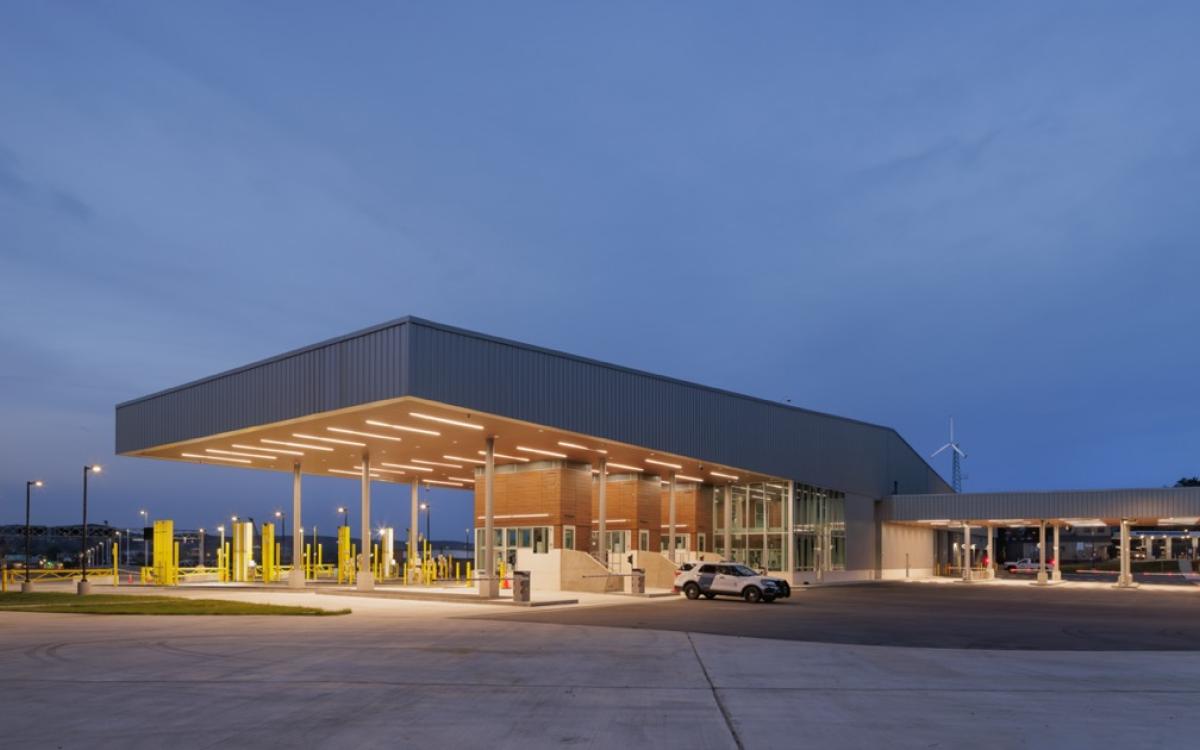
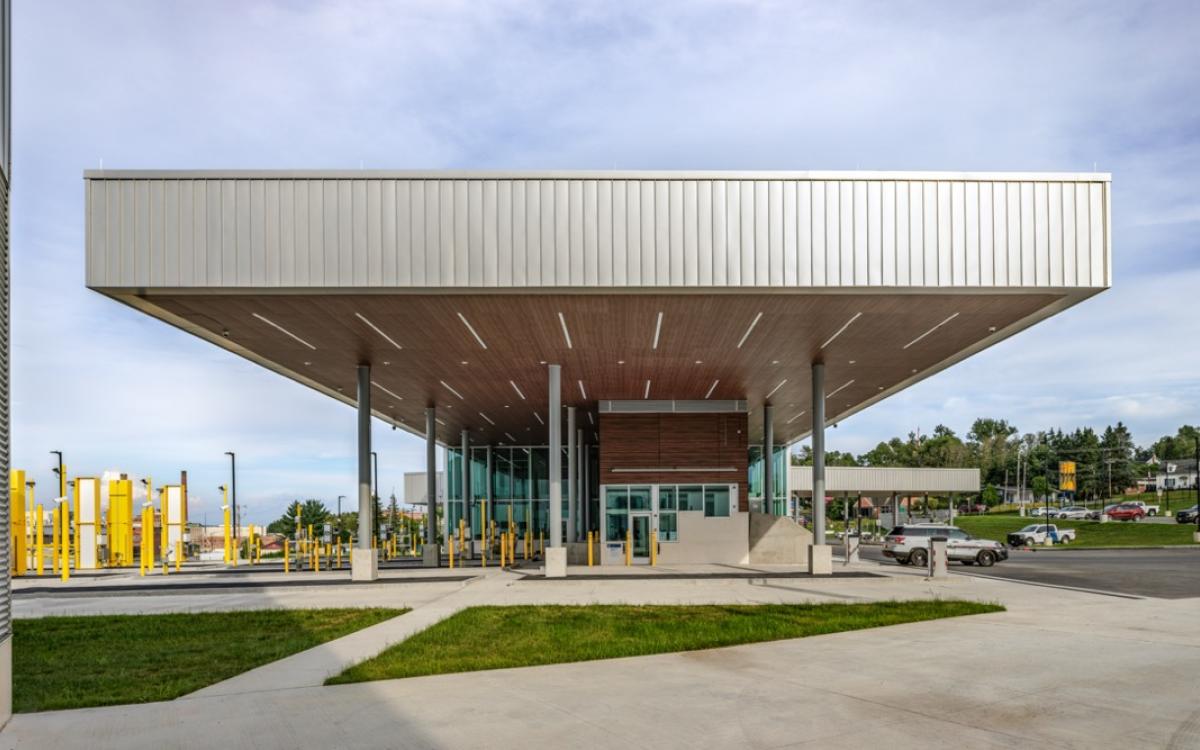
Madawaska, ME
United States
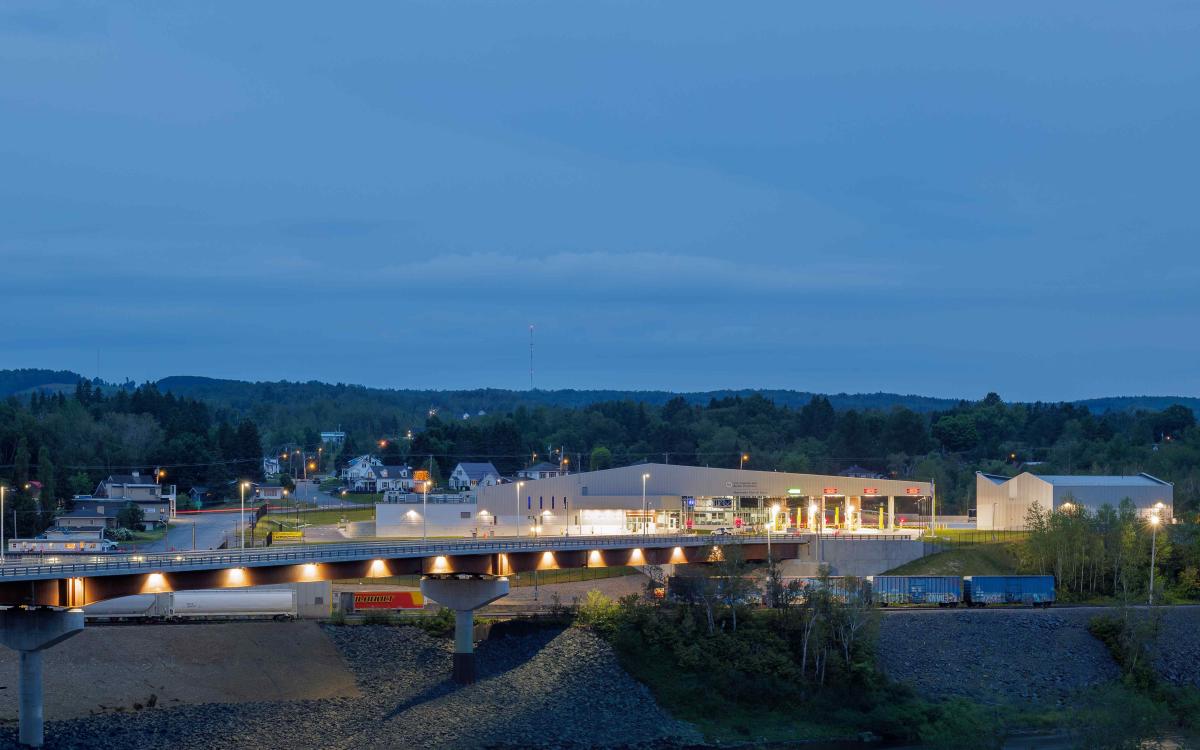
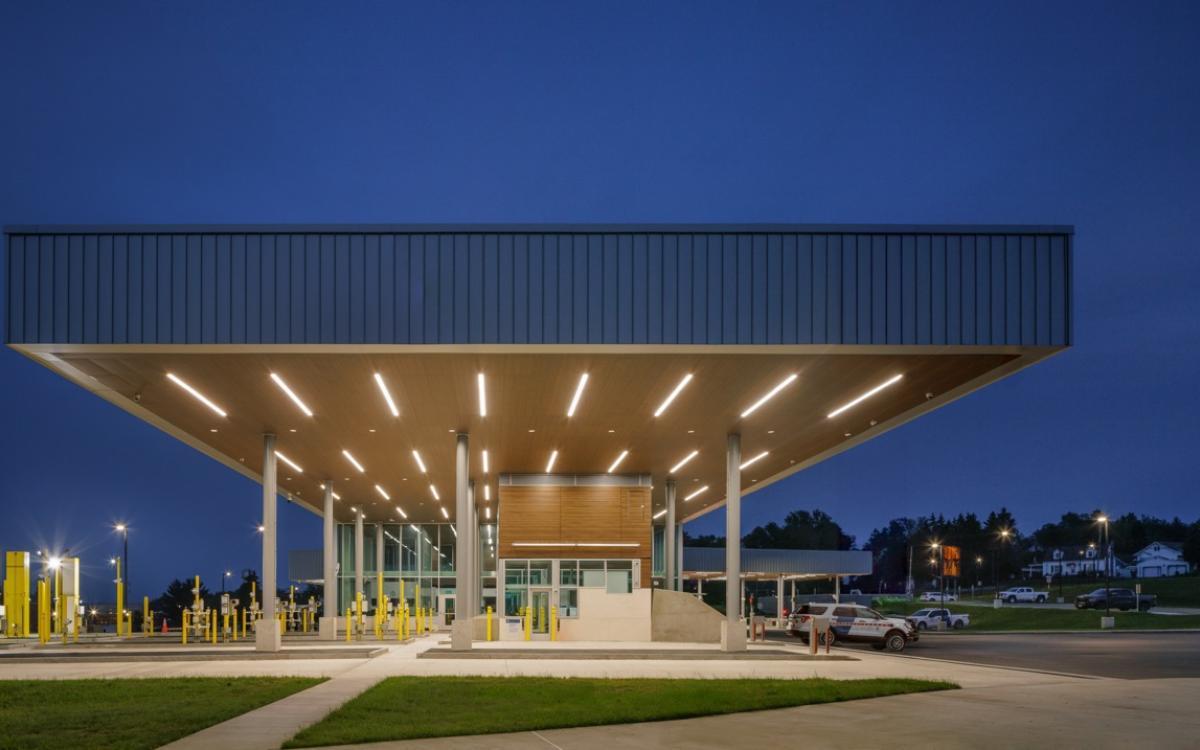
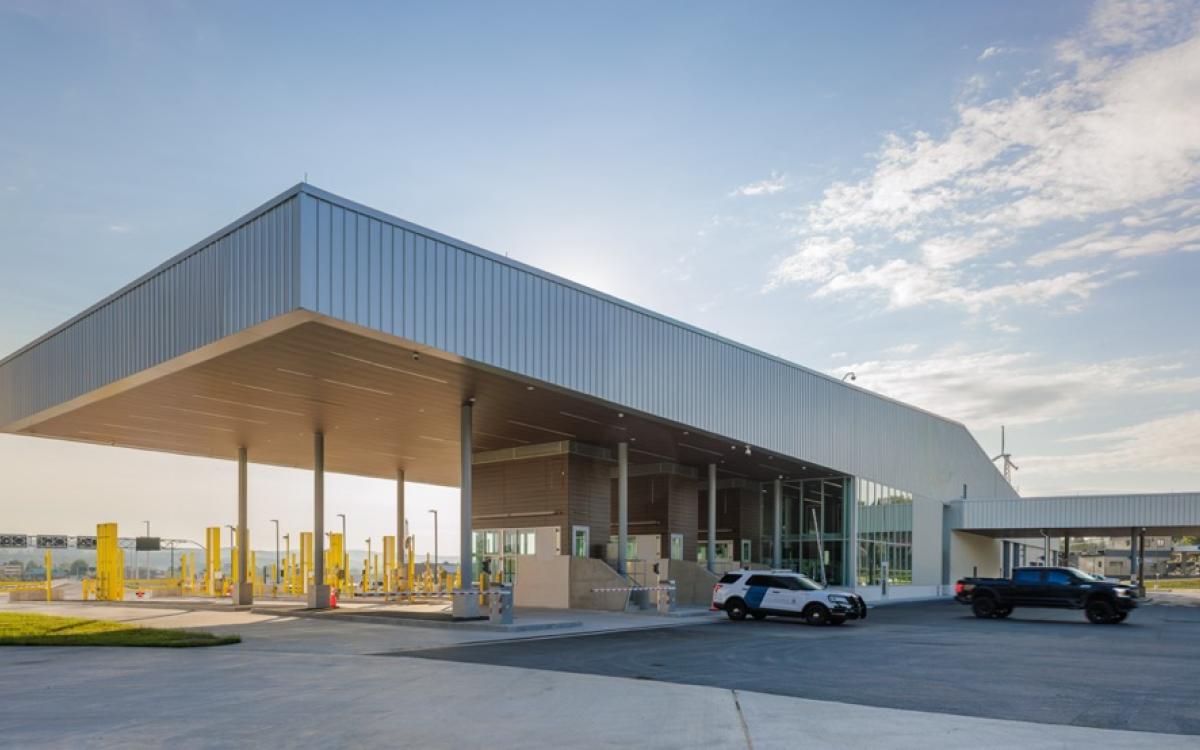
The new U.S. Madawaska Land Port of Entry (LPOE) is situated on a bluff in Madawaska, Maine, one of the four corners of the country and the northernmost town in New England. It’s an international border crossing that serves everything from commercial trucks to people on snowmobiles.
The previous facility connected the town with New Brunswick, Canada, via the International Bridge over the St. John River. With the bridge nearing the end of its useful life, both a new bridge and a new LPOE building were needed for the 10.7-acre site.
Improved flow and function drove design, and the team was tasked with balancing a welcoming site experience with security requirements, all while respecting the boreal forest terrestrial biome.
The project team knew just how to achieve this goal: design to SITES certification, a holistic approach to regenerative landscapes.
SITES on Sustainability
SITES, administered by Green Business Certification Inc., offers performance measures in addition to prescribed solutions for sustainability. The tiered certification system encourages the design of resilient outdoor spaces, with a points scale to measure improvements, from reduced water demand and stormwater runoff, enhanced biodiversity, protection of critical habitat, reduced energy consumption, improved air quality and more.
Paired with Leadership in Energy and Environmental Design (LEED), buildings and surrounding landscapes are designed in harmony, with sustainability and resilience underlining every decision. The LPOE project is pursuing both a SITES Silver and a LEED Gold rating.
For this facility, the client chose a previously developed site that was no longer in use, which allowed the team to remediate underground tanks, revegetate with native plantings, preserve undeveloped land and bring additional uplift to the surrounding environment and community.
And there are SITES points to support that choice.
To make the project truly restorative, the design utilized several SITES resilience features to increase sustainability and achieve the desired certification levels. Roofing and pavement materials were selected to reduce urban heat island effects. Lighting fixtures were chosen based on Backlight-Uplight-Glare ratings to minimize impact on the circadian rhythms of surrounding wildlife while ensuring visibility for occupants.
A surface stormwater basin was designed to retain runoff from the 95th percentile design storm, with infiltration to collect and treat stormwater runoff from at least 95 percent of the impervious area of the project. Hearty indigenous vegetation was restored to the site, eliminating the need for irrigation, while improving site stabilization.
Rolling with Topography
The new 36,000-foot facility had to be constructed with minimal environmental impact during demolition of the previous buildings on-site to adhere to the SITES framework. The west portion of the site also contained a creek that was placed within a Vegetation Protection Zone, a concept specific to SITES that prevents large equipment from disturbing the natural environment during the construction phase.
Topography provided both a challenge and an opportunity for low impact design. Bounded by a bluff on the north side and an urban roadway on the south side, the site has a total elevation change of around 45 feet. To address this steep incline, the site program occurred in a series of terraces: bridge landing, primary and secondary inspection, parking and roadway access.
On a site with significant topographic change, stormwater management can also be a challenge — especially so in an area that receives around 170 inches of annual snowfall and needs to operate 24/7. Stormwater was collected in a combination of systems to effectively treat and route the area, including a closed drainage system and open grassed swales that conveyed the stormwater to an onsite infiltration basin.
Designers used glacial kettles, essentially a pond or lake, as a model for stormwater retention, since they can be sculpted to weave into the site. Glacial moraines provided inspiration for the large open spaces. Moraines are formed as glaciers move, leaving behind rocks, soil and other debris. This simple strategy took the challenges of the site and turned them into the main design feature.
Dedicated snow storage areas were also carved into the topography to allow for plow trucks to efficiently move solid-state precipitation to holding areas. Consideration was also given to meltwater patterns and how snowmelt can be filtered on-site instead of burdening offsite areas, all of which garnered points for stormwater management under SITES.
Nature Positive, Future Ready
Topography like that at Madawaska can often lead to the need for retaining walls. But retaining walls tend to have enormous carbon footprints. To limit the embodied energy associated with this site, the team instead used vegetated terracing to divide the landscape into simple slopes. This strategy enables both construction cost savings and carbon footprint reduction for the site work — an important goal for minimizing environmental impact.
Nature was harnessed to maintain clear sightlines from the building and personnel booths for security. The design minimizes view-obstructing woody trees and shrubs and instead installed herbaceous planting sweeps reminiscent of Maine’s natural hillside “carpets.”
The carpet solution provided a subtle and beautiful aesthetic patterning and incorporated enough native plants to pursue SITES credits for conserving and using native plants and restoring native plant communities.
Careful attention was also paid to regional pollinators like hummingbirds, butterflies and bees. The adjacent stream corridor provides many of the environmental factors needed for a healthy population, and the developed landscape at Madawaska LPOE builds upon what already exists. As the plantings mature, the LPOE will continue to contribute to this important group of birds and insects.
Cost Resilience
Resilience strategies, including nature-based solutions, sometimes cost more upfront but ultimately have a lower lifecycle cost thanks to operational and repair saving. However, there are several instances where the benefits of resilient design are immediately evident.
At Madawaska, opting for planted slopes over retaining walls saved a percentage of upfront cost. The team was able to further save on capital costs by selecting native meadowland vegetation and eliminating the irrigation system. The cost of plant material is roughly equivalent for native and non-native species, making the upfront financial impact of this decision a net positive.
Further, asset protection associated with resilient rainwater management strategies can reduce the risk of property damage. In addition, a roof-mounted photovoltaic system supports the building and site energy use for lighting and electric site maintenance equipment, saving money annually on energy costs.
SITES-supported design and planning decisions also help to sustain high-performance operations, maintenance and monitoring. Solutions here included onsite composting to limit waste, integrated pest management planning to safely manage toxic pesticides and the use of low-emissions maintenance to support the ongoing health of facility occupants and the surrounding environment.
Project team
- Client: U.S. General Services Administration
- SITES Certification Consultant: WSP
- Architect: Siegel
- Designer of Record: Monica Ponce de Leon Studio
- Landscape Architect: Agency Landscape + Planning
- Civil Engineer: VHB
- Construction Manager as Agent: Procon Consulting
- Design-Build Contractor: J&J Contractors, Inc
Photo credit: Paul Warchol