About Us Products FAQs Participants Funders
Why Sustainable Sites Hydrology Soils Vegetation Materials Human Health & Well-being
Case Studies Case Study Images
Report Presentations Next Steps Pilot Program
Contact Us News Releases Email Updates

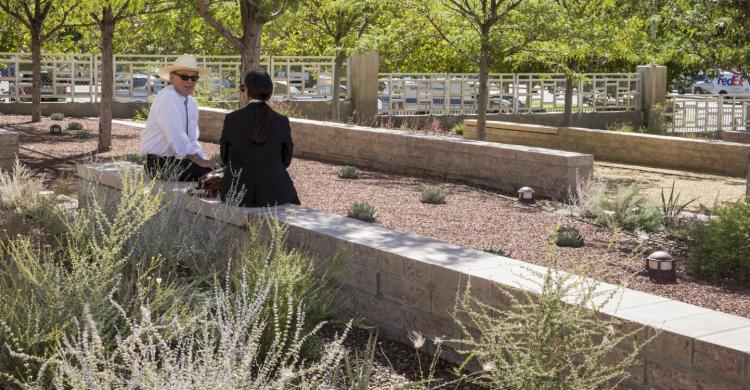
Outdoor eating patio

Cayuga Medical Center Main Campus

Size & Type of Project:
Main Campus is approximately 24 acres of parking, building and green space; Greyfield redevelopment

Location:
Ithaca, New York

Budget:
$32.5 million (distributed among several building additions and phases) of which, approximately $6.7 million was for site-related construction costs

Project Phase:

Completed in Spring 2008

Project Overview

In response to the needs of a local, rapidly expanding medical facility, a master plan was created for the Cayuga Medical Center (CMC) to guide future development and identify major design and sustainability goals for the hospital. Cayuga Medical Center expressed a desire to create a comprehensive healing environment both indoors and out. Having a green building and a sustainable site was a central focus for the client and design team. The project purpose was to develop an overall architectural and site master plan, and to direct several years of building and site work in adherence with sustainability goals. The overall vision included creating seamless spaces between architecture and exterior garden spaces.

Investment in a master plan, an early commitment to sustainable practices, and a belief in the ability of landscape spaces to improve human health and well-being has guided design projects at the hospital for the last six years. Its attention to the health and well-being of visitors and patients is exemplified in the outdoor garden environments, whether as views from windows or near entrances.  The southwest addition, the largest of the phases, is anticipated to receive LEED silver certification by the U.S. Green Building Council for incorporating key sustainable principles in its planning, design and construction.

Site Context

Ithaca sits on the southern shore of Cayuga Lake, in central New York State.  The natural vegetation of the Ithaca area, northern temperate broadleaf forest, is dominated by deciduous trees. Ithaca experiences a moderate continental climate, with cold, snowy winters and sometimes hot and humid summers.  Ithaca receives an average of 42 inches of rainfall a year, half of which is in the form of snow.  The average winter temperature is 22 degrees Fahrenheit while the average summer temperature is 69 degrees Fahrenheit.

Site changes for Cayuga Medical Center were made to the entire campus, and several additions/ renovations were undertaken to the hospital itself. Additions/improvements were phased-in over a number of years. The major projects were associated with building additions, including an expansion of the education center with basic site work, an addition to the cafeteria with exterior gardens and eating spaces, the creation of a radiation oncology center with exterior gardens and site work, an emergency room addition (southwest addition) with waiting room exterior garden spaces.  Major landscape improvements included creating a new garden/gathering space to replace a garden that the footprint of the southwest addition would occupy, designing parking, entry and circulation changes and installation of a porous pavement parking lot. A master plan was first prepared that included a comprehensive and holistic approach to the site, stormwater management and architecture.


Restorative garden

Sustainable Practices

Providing restorative spaces and views of natural environments: A belief that landscape experiences, even views from a window, benefit human health and well-being led to a commitment to develop a variety of garden spaces on the hospital campus.

Wayfinding and site circulation improvements: New building additions and entries allowed for the development of clearer site circulation patterns and wayfinding cues. A comprehensive parking study and detailed parking management plan was developed to meet the needs of parking for the hospital while minimizing the addition of paved surfaces and loss of green space. As a result, parking and circulation was re-organized on site. This included moving staff parking away from the nearest entrances, clarifying the arrival sequence, and instituting a parking permit system. Managing parking resources in this way gives priority to patients and visitors for prime parking spaces while minimizing the need for constructing new parking to accommodate growth on campus. The site design included thoughtful development of information needs, such as clear signage for hospital patrons. In addition, a bus stop, bicycle racks, and pedestrian walkways were instituted to help visitors and patients navigate safely around the campus and adjacent properties.

Use of porous pavement: When proposed, the new building additions would have displaced some of the existing parking. The parking study revealed that some additional parking would be necessary to accommodate ten-year projected growth for the hospital. A parking area with approximately 106 spaces was created to fill that need. While adding parking spaces added impervious surfaces, every attempt was made to identify strategies for minimizing the increase. Over two-thirds of the additional parking spaces (69) were constructed in a porous pavement lot. The remaining section of parking was directly uphill of the hospital building, and it was decided not to risk storing water underground above the emergency room.

Minimize impervious surfaces/ Increase water infiltration Overall, there was a campus-wide strategy to increase water infiltration and reduce impervious surfaces. This included incorporating strategies such as converting lawn areas to garden space or to a no-mow meadow, using the porous pavement, and installing a bioretention basin and a pond.

Minimize irrigation needs: Native and other plants adapted to site conditions and the local climate were chosen for campus plantings. All landscape areas, including the green roof, do not require permanent irrigation systems.

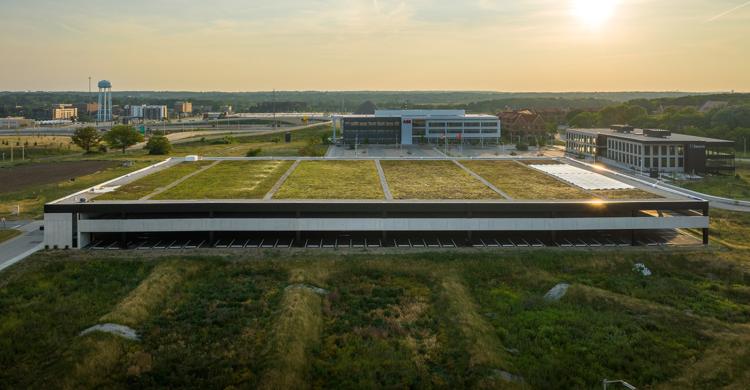
Stormwater management: Specific sustainable elements in stormwater management include the construction of a retention pond with a meadow planting, bioretention basin, a 700-square-foot intensive green roof, and a porous pavement parking lot. Planted with moisture-loving grasses and shrubs, the bioretention basin holds and treats stormwater from parking areas before it enters the municipal system. Planted with wetland species and surrounded by meadow, the retention pond handles stormwater quantity and quality needs for the campus.

Construction Cost

One of the client's goals for this project was to reduce life-cycle costs rather than minimize the initial construction costs. Due to the implementation of non-traditional, sustainable design elements, some installation costs were higher, on average, than conventional construction costs.

Monitoring Information

Project managers frequently evaluate the site and communicate with the client regarding the performance and effectiveness of the landscape elements. Monitoring of the porous pavement lot, bioretention basin, retention pond, green roof, and other improvements on the Cayuga Medical Center campus consists mainly is observational. Because it is the first porous pavement parking lot installed in the greater Ithaca area, several local educational workshops have included site visits to the campus to see the lot first-hand.Formal monitoring of patient's recovery times or responses has not been done. Anecdotally, it is clear that people use the outdoor spaces regularly, and enjoy them. Preliminary inquiries have been made to the hospital asking for feedback from staff and/or patients regarding the campus improvements (circulation, wayfinding, waiting rooms with a view to gardens, outdoor restorative spaces, etc.).

Maintenance

The green roof requires maintenance twice a year, once in spring and once in fall to maintain the plantings. The cost of this strategy is unknown, as campus grounds people maintain the space as part of their regular maintenance schedule. The meadow requires less to maintain over its life cycle, with mowing only once a year. This is significantly less than a typical tree-and-lawn campus landscape, where mowing can occur as often as twice a week throughout the growing season.  The hospital has experienced savings in fertilizer, gasoline and labor because the meadow is mowed only once per growing season. The porous pavement lot may require vacuum cleaning every five years or so over the course of its lifetime. The porous asphalt lot is still new enough, however, that it is functioning well and has not yet needed this treatment. The lot requires less plowing and needs less salt applied compared to a conventional lot, which is a maintenance and cost savings.


Issues/Constraints of the Site

Lessons Learned

More project details

http://www.twla.com/projects/healthcare/

Project Consultants

OWNER
Cayuga Medical Center
Contact: Louis LoVechhio
Assistant Vice President

PROJECT CONSULTANTS

Landscape Architect Project Manager
Kimberly Michaels, RLA, LEED AP
Senior Landscape Architect
Trowbridge & Wolf, LLP

Principal Landscape Architect
Peter Trowbridge, FASLA
Principal
Trowbridge & Wolf, LLP

Lead Architect
Paul LeVessque II, AIA, LEED AP
Principal Associate
HOLT Architects, PC

Principal Architect
Larry Hoffman
Founder and Senior Healthcare Facilities Planner
HOLT Architects, PC

Civil Engineer
Frank Santelli, PE
Principal and Senior Design Engineer
TG Miller, PC

Principal Civil Engineer
David Herrick, PE
Principal
TG Miller, PC

Environmental Consultant
Andrew Potts, LEED AP
Cahill Associates